Swapr V3 lets providers manage liquidity ranges on Gnosis Chain
Swapr V3 is an automated market maker with concentrated-liquidity pools on Gnosis Chain. Liquidity providers choose the interval their assets support. A position earns swap fees from trading within its range, then becomes inactive when the pool price moves beyond its boundaries. Managing those bounds changes both capital concentration and the balance between tokens. Manual positions and automated management handle that task differently.
Updated:
Range management concerns the position itself. An automated liquidity manager can adjust ranges and reinvest fees under a strategy's rules. A farming campaign adds separate token incentives. Neither a campaign reward nor a pool-wide fee rate describes an individual position's return.
Rebalancing a V3 position changes its token exposure and incurs execution costs, so more time in range doesn't necessarily mean higher profit.
Range Width and Trading Participation
A narrower price band concentrates a position's capital around fewer prices, increasing the liquidity it can supply there while reducing the room for price movement. Within overlapping ranges, concentration can increase liquidity depth per unit of deposited capital. Fee income still requires swaps through that interval and depends on how much competing liquidity is active.
A wider band gives the pool price more room to move before liquidity becomes inactive. It also commits capital to prices farther from the current market. A narrow range may collect fees more intensively during trading within it, then spend a prolonged period inactive. Actual trading during active periods determines fee income. A concentrated position can therefore earn less over an entire holding period despite providing greater depth near the starting price.
Wider bounds don't insure a deposit against losses in the paired tokens. Range width controls liquidity placement, while token prices still affect its value.
Price Direction and Token Balances
A V3 position's token composition changes as trading moves the pool price through its range, so deposited amounts don't remain fixed inventory. With price expressed as quote tokens per base token, a rising price leaves less base token and more quote token. A falling price moves the balance the other way. Beyond the upper boundary, the position's liquidity consists of the quote token; below the lower boundary, it consists of the base token. Previously earned fees can remain separately owed in either token.
Impermanent loss describes the shortfall in a position's token value relative to holding its original tokens at the same later prices, before fees and rewards. Fee income may offset that difference. Automated management can change the range, but it doesn't remove the position's underlying token exposure.
Ticks and Individual Liquidity Positions
Ticks are discrete price points the protocol uses to define a position's lower and upper bounds. A pool's tick spacing constrains the permitted endpoints. Manual positions created through the Algebra position manager use non-fungible tokens (NFTs), which identify their individual liquidity and bounds. Different positions in the same pool can consequently cover different intervals. Pool-wide liquidity therefore doesn't establish whether a particular position participates at the current price. The position's own bounds and remaining liquidity determine that status, while its accrued fees form a separate balance.
Manual Ranges and Gamma Management
Manual range selection keeps the bounds under the liquidity provider's control; an automated liquidity manager (ALM) applies a strategy to manage those bounds. Swapr's February 15, 2024 V3 announcement described a Gamma integration for range management and automatic fee compounding. A managed strategy is an alternative only where it supports the selected pool and remains available.
Rebalancing changes where liquidity sits on the price curve. Compounding reinvests earned fees as additional liquidity. A strategy may perform both operations, although reinvesting fees doesn't guarantee its range will remain active through the next price move. The choice involves the strategy's range rules and its additional contracts, alongside the underlying pool.
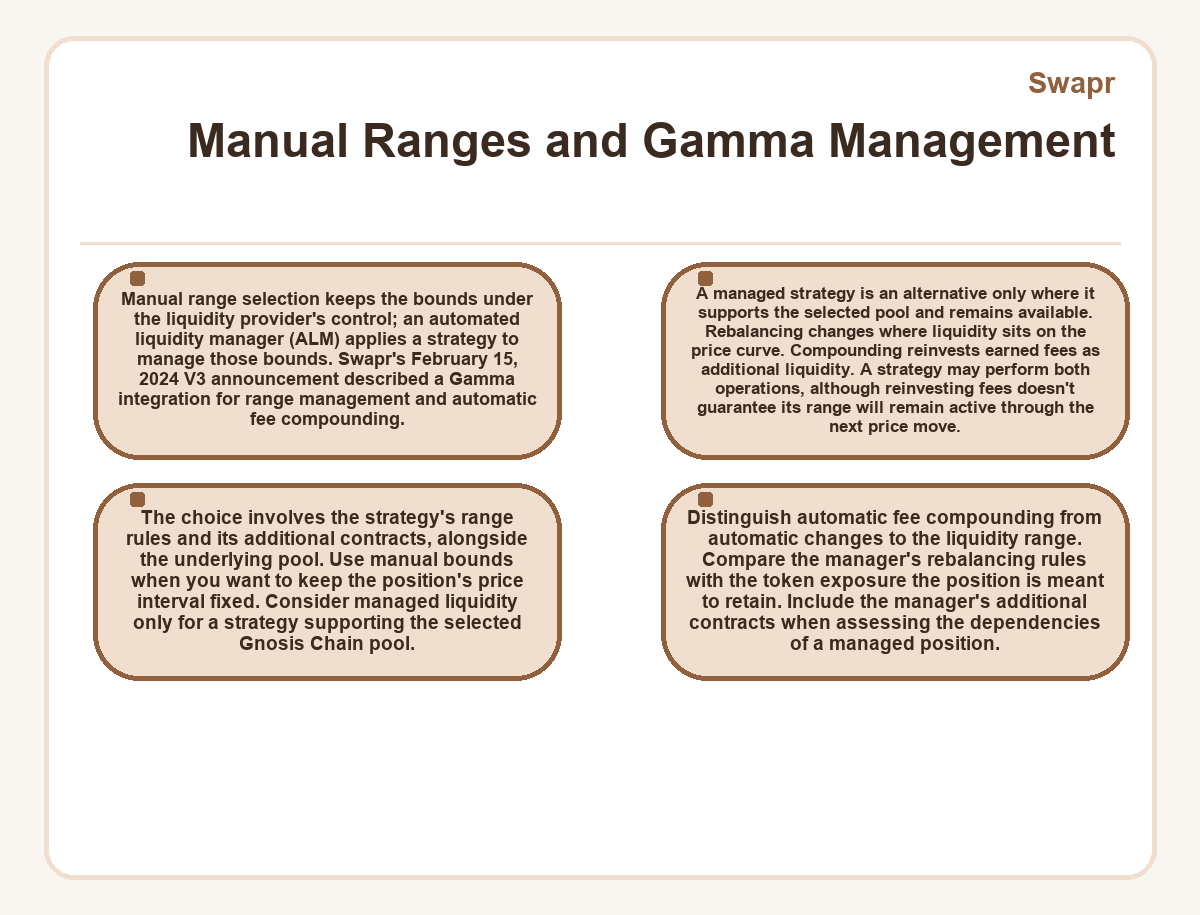
- Use manual bounds when you want to keep the position's price interval fixed.
- Consider managed liquidity only for a strategy supporting the selected Gnosis Chain pool.
- Distinguish automatic fee compounding from automatic changes to the liquidity range.
- Compare the manager's rebalancing rules with the token exposure the position is meant to retain.
- Include the manager's additional contracts when assessing the dependencies of a managed position.
Pool Fees and Liquidity Incentives
Swap fees fund income for active liquidity providers, while farming rewards follow a separate campaign's terms. The pool's fee rate applies to swaps; it isn't an annual return on a provider's deposit. Individual fee income also reflects the volume passing through the range and the position's share of active liquidity. Adjustable fees change the charge for trading. Changing that charge doesn't, by itself, move a manual position's lower or upper bound.
The February 15, 2024 V3 announcement also reported active SWPR farming campaigns. In its February 16, 2024 follow-up, the team described Merkl incentives favoring concentrated liquidity for certain stable or pegged pairs. Campaign rewards follow their eligibility rules and reward periods. Trading fees can continue independently after a reward campaign ends.
Range Exits and Repositioning Costs
An out-of-range position retains its remaining pool assets, although those assets no longer supply liquidity at the current price. An unchanged position becomes active again if the pool price returns inside its range. This makes a temporary range exit different from removing liquidity. Moving capital into another interval changes which prices it covers and the token mix the new position requires. Repositioning can restore participation when the replacement range includes the pool price.
A manual position's range bounds remain fixed. Shifting liquidity to different bounds requires removing liquidity from the old interval and allocating it to a new position. Contract interactions incur network costs. If repositioning also requires a token swap, its trading costs and price impact enter the calculation.
Time in range measures participation, not overall profit. A position's value also reflects token prices, earned fees, incentives, and execution costs. More active time can still produce a worse net outcome when those costs outweigh the additional fee income.
Common questions about Swapr
-
Can I Collect V3 Fees While My Position Is Out of Range?
- Previously accrued swap fees remain collectible when a manual position is out of range. The inactive state stops new fee earnings from swaps outside its bounds; it doesn't erase amounts already owed. Collecting fees doesn't require moving the position into a new interval.
-
Is Slippage Tolerance Part of a V3 position's Price Range?
- Slippage tolerance constrains acceptable execution changes for a liquidity transaction, while price bounds define where the position supplies liquidity. The Algebra position manager uses minimum token amounts as execution checks. Changing that tolerance doesn't widen the position's range or keep its liquidity active.
-
How Do V3 Range Bounds Change When I Reverse the Price Quotation?
- Reversing the quotation replaces positive prices with their reciprocals and reverses the endpoint order. Using human-readable token units, the inverse lower bound is one divided by the original upper bound. The inverse upper bound is one divided by the original lower bound. This changes the quotation, not the underlying position.
-
Why Can a V3 Deposit Require Unequal Values of Its Two Tokens?
- The required deposit ratio follows the selected bounds and the current pool price. A range needn't sit symmetrically around that price, so an equally valued split isn't a universal requirement. For a range entirely outside the current price, the liquidity can consist of one token.
-
Does Removing All V3 Liquidity Automatically Destroy the Position NFT?
- The Algebra position manager treats removing liquidity and burning its position NFT as distinct operations. Burning requires zero remaining liquidity and collection of all tokens owed. An empty NFT can therefore remain after liquidity removal; ownership of that NFT alone doesn't establish an active liquidity balance.
-
Does Selecting the Full Range Turn a V3 Position Into a V2 LP Token?
- A full-range manual V3 position remains a V3 position represented by its position NFT. Selecting the widest supported bounds changes its price coverage, not its token standard. It doesn't convert the position into the fungible pool shares used by the original pair-pool model.